
change management
What is change management?
Change management is a systematic approach to dealing with the transition or transformation of an organization's goals, processes and technologies. The purpose of change management is to implement strategies for effecting and controlling change and helping people to adapt to change.
Change management activities range from individual projects to large programs, such as digital transformation that introduces many new processes and applications. Change efforts often involve management teams and other stakeholders. Department-level management and employee buy-in is essential.
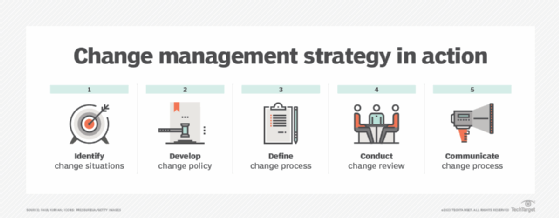
To be effective, a change management strategy must do the following:
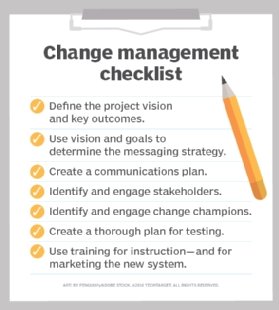
- Consider how a change will impact processes, systems and employees.
- Include planning and testing the change, scheduling and implementing it as well as documenting and evaluating its effects.
- Provide documentation to maintain an audit trail if a rollback becomes necessary and ensure compliance with internal and external controls, including regulatory compliance.
How does change management work?
To understand how change management works, it helps to apply its concepts and tools to specific areas of business. Below are examples of how change management works for project management, software development and IT infrastructure.
Change management for project management
Change management plays an important role in project management because each change request must be evaluated for its impact on the project. Project managers, or the senior executives in charge of change control, must examine how a change in one area of a project could affect other areas and what impact that change could have on the project as a whole. Project areas that change control experts should pay particular attention to include the following concerns:
This article is part of
The evolving CIO role: From IT operator to business strategist
- Scope. A change request could affect the project scope.
- Schedule. A change request could alter the project schedule.
- Costs. Labor is typically the largest project expense and changes that increase time to complete also raise project costs.
- Quality. Change requests might affect the quality of the completed project. For example, accelerating the project schedule can affect quality when work is rushed.
- Human resources. A change request might entail bringing on additional or specialized labor. Also, when the schedule changes, key resources might be moved to other assignments.
- Communications. Change management is interactive. Approved change requests must be communicated to the appropriate stakeholders at the right time.
- Risk. Change requests must be evaluated to consider risks they pose. Even minor changes can have a domino effect on the project and introduce logistical, financial or security risks.
- Procurement. Changes to the project can affect when, where and how materials and contract labor are procured.
When an incremental change is approved, the project manager documents the change in one of four standard change control systems to ensure all thoughts and insight have been captured with the change request. Changes that aren't entered through a control system are labeled defects. When a change request is declined, this is also documented and kept in the project archives.
Change management for software development
In software development project management, change management strategies and tools help developers manage changes to code and its associated documentation as well as help chief information officers and project managers keep projects on track. Agile software development environments encourage changes made to satisfy requirements or adjust the user interface. However, changes aren't addressed in the middle of an iteration. They're scheduled as stories or features for future iterations.
Version control software tools assist with documentation and prevent more than one person from making changes to code at the same time. Such tools can track changes and back out changes when necessary.
Change management for IT infrastructure
Change management tools are also used to track changes made to an IT department's hardware infrastructure. As with other types of change management, standardized methods and procedures ensure every change made to the infrastructure is assessed, approved, documented, implemented and reviewed in a systematic manner.
Changes made to hardware settings are also referred to as configuration management. Technicians use CM tools to review the entire collection of related systems and verify the effects a change in one system has on other systems.
Types of organizational change
Change management can be used to manage many types of organizational change. The three most common types are the following:
- Developmental change. Any organizational change that improves previously established processes and procedures.
- Transitional change. Change that moves an organization away from its current state to a new state to solve a problem, such as implementing a merger and acquisition or automating a task or process.
- Transformational change. Change that radically and fundamentally alters the culture and operation of an organization. The result of transformational change might not be known ahead of time. For example, a company may pursue entirely different products or markets.
Popular models for managing change
The best models provide guiding principles and help managers align the scope of proposed changes with available digital and nondigital tools. Popular models include the following:
- ADKAR. Prosci founder Jeff Hiatt created the ADKAR model. It consists of five sequential steps:
- Awareness of the need for change.
- Desire to participate and support the change.
- Knowledge of how to change.
- Ability to implement desired skills and behaviors.
- Reinforcement to sustain the change.
- Prosci 3-Phase Process. This expands on the ADKAR model and includes three phases: preparing for change, managing change and reinforcing change. It provides a comprehensive framework for managing change initiatives.
- Bridges Transition Model. Change consultant William Bridges created a model that focuses on how people adjust to change. The model has three stages: one for letting go, a second stage of uncertainty and confusion and a third one of acceptance. This model is sometimes compared to the Kübler-Ross five stages of grief: denial, anger, bargaining, depression and acceptance.
- IT Infrastructure Library. The ITIL framework offers detailed guidance for managing change in IT operations and infrastructure. Axelos, a joint venture between Capita and the U.K. Cabinet Office, created it.
- Kotter's 8-Steps for Leading Change. Harvard University professor John Kotter's model has eight steps:
- Create a sense of urgency.
- Build a guiding coalition.
- Form a strategic vision and initiatives.
- Enlist a volunteer army.
- Enable action by removing barriers.
- Generate short-term wins.
- Sustain acceleration.
- Institute change.
- Lewin's Change Management Model. Psychologist Kurt Lewin created a three-step framework that is also referred to as Unfreeze, Change, Refreeze model.
- McKinsey 7-S Framework. Business consultants Robert H. Waterman Jr. and Tom Peters designed a model to look holistically at seven factors that affect change: shared values, strategy, structure, systems, style, staff and skills.
- Agile change management. This approach integrates agile methodologies into change management to boost flexibility and responsiveness to changes during a project's lifecycle.
- Nudge theory. Developed by Richard Thaler and Cass Sunstein, this theory suggests that gentle nudges can influence behavior and decision-making. In the context of change management, it is used to subtly guide people and organizations through changes.
What are the benefits of change management?
Taking a structured approach to change management helps organizations mitigate disruption, reduce costs, reduce time to implementation, improve leadership skills, drive innovation and improve morale. In addition, there are ways change management can add structure to IT and operations:
- Improved documentation of enterprise systems.
- Greater alignment between suggested change and what gets implemented.
- Better starting point for automation initiatives.
- Clearer understanding of why systems were made.
- Ability to reverse-engineer changes made to existing business processes and infrastructure.
- Better ability to identify what can be safely eliminated or updated.
What are the challenges of change management?
Companies developing a change management program from the ground up often face challenges. Besides a thorough understanding of company culture, the change management process requires an accurate accounting of the systems, applications and employees that changes are likely to affect. Additional change management challenges include the following:
- Resource management. Managing the physical, financial, human, informational and intangible assets and resources that contribute to an organization's strategic plan becomes increasingly difficult when implementing change.
- Resistance. The executives and employees most affected by a change might not be amenable to it, resulting in a backfire effect. In many cases, this happens because people perceive that change will result in extra work. Transparency, training, planning and patience can help quell resistance and improve overall morale. Additionally, care should be paid to address and manage the emotional journey of employees during change.
- Communication. Companies often fail to consistently communicate change initiatives or include employees in the process. Change-related communications plans require an adequate number of messages, the involvement of enough key stakeholders to get the message out, and the use of multiple communication channels.
- New technology. The application of new technologies can disrupt an employee's entire workflow. Companies can improve adoption of new technology by creating a network of early learners who champion the new technology to colleagues.
- Multiple points of view. In any change initiative, success criteria may differ for people based on their roles in the organization and incentives. Managing the impact of these factors is challenging.
- Scheduling issues. Deciding whether a change program will be long or short term and clearly defining milestone deadlines is complicated. Some organizations believe shorter change programs are most effective. Others believe a more gradual approach to change reduces resistance and errors.
Importance of a change management plan
As a conceptual business framework for people, processes and the organization, change management increases the success of critical projects and improves a company's ability to adapt quickly. Business change is constant and inevitable. But when poorly managed, it can cause organizational stress as well as unnecessary and costly rework.
By standardizing the consistency and efficiency of assigned work, successful change management assures that the people affected by changes aren't overlooked. As changes to work occur, change management helps employees understand their new roles and build a more process-driven culture.
Change management also helps companies remain dynamic in the marketplace and encourages future growth.
Principles of change management
Three principles of organizational change management build on the three stages of change management introduced by Kurt Lewin in his book Principles of Topological Psychology:
- Unfreeze the current state. Change agents need to identify what precisely they want to change. They must formulate a "why" that other participants are likely to buy into. In essence, they need to reverse-engineer the future state and translate this benefit to other possible participants. Then they get people to participate in the new idea. This could include executive sponsorship for a big change or co-workers for a departmental change.
- Change the system. At this stage, change agents and any collaborators can put the change into practice. The change agents must work with collaborators to communicate the idea and bring other participants on board. It is important to pay attention to any pushback and find areas of shared understanding to either help move the change forward or shift its implementation in response to feedback. Tension might be high as everyone gets used to the new system. It's important to be respectful of their feelings and ideas.
- Refreeze. Eventually, people get used to the new system, or they revert to what was working before. At this stage, it is important to declare that the change is over whether accepted or rejected. Even if the change was rejected, declaring it over gives everyone a chance to relax. It is also helpful at this stage to document what happened for future reference.
The impact of digital transformation on change management
Digital transformation has significantly accelerated change management processes in organizations. As businesses increasingly adopt digital technologies, the pace at which changes must be implemented has increased.
Digital transformation initiatives often involve the integration of new technologies, the restructuring of processes and the adaptation of organizational cultures. This necessitates a more responsive approach to change management to ensure that transformations are implemented successfully and yield the desired outcomes.
Change management and digital transformation are intrinsically linked, with each driving the success of the other. Effective change management is crucial for the successful implementation of digital transformation initiatives. It ensures that the workforce adapts to new technologies and processes, and that the organizational culture evolves to embrace digital advancements.
Integrating change management with digital transformation involves aligning the objectives of both approaches to ensure a seamless transition. Change management strategies must be designed with a clear understanding of an organization's digital goals, ensuring that change initiatives support and enhance digital transformation efforts. This integration helps mitigate resistance, enhance stakeholder engagement and ensure the digital transformation's benefits are realized.
The integration of digital tools and platforms has enabled organizations to execute change initiatives more swiftly and efficiently. For example, cloud computing facilitates faster deployment of new applications and services, while collaboration tools enable better communication and coordination among team members regardless of their physical location. This digital enablement helps organizations respond faster to market changes, competitive pressure and customer demands.
Role of data analytics and AI in change management
Data analytics and artificial intelligence (AI) play a pivotal role in enhancing the effectiveness of change management. These technologies provide insights that can inform the planning, execution, and evaluation of change initiatives. By analyzing data and using AI, organizations can identify patterns, predict outcomes, and make informed decisions about where and how to implement changes.
In the planning phase, these tools can identify areas that require change and prioritize change initiatives based on their potential impact. During execution, AI can streamline processes by automating routine tasks and freeing up human resources to focus on more complex aspects of the change management process. AI also provides real-time feedback and analytics, enabling managers to monitor progress and make adjustments as needed.
In the evaluation phase, data analytics and AI can assess the success of change initiatives, providing insights into what worked well or didn't. This helps in refining future change management strategies, ensuring continuous improvement and adaptation to the evolving digital landscape.
The synergy of technology with change management is essential for businesses seeking to thrive in the digital age, where adaptability and responsiveness are key to success.
Popular change management tools
Digital and nondigital change management tools can help change management officers research, analyze, organize and implement changes. In a small company, the tools might consist of spreadsheets, Gantt charts and flowcharts. Larger organizations typically use software suites to maintain digital change logs and provide stakeholders with an integrated, holistic view of change and its effects.
The following examples of change management software applications were gathered from sources such as Capterra and G2 as well as various software reviews:
- 360Learning. This tool lets employees create learning content to help others learn about and adjust to changes.
- Asana. While not exclusively a change management tool, Asana helps in managing tasks and projects, facilitating the tracking and coordination of change initiatives.
- Freshservice by Freshworks. An online ITIL change management product that offers workflow customization, automation and gamification features to manage IT service changes.
- SurveyMonkey. This tool lets change managers create surveys to track and gauge how changes are working or not working as they're rolled out.
- Tableau. This business intelligence application lets managers build dashboards with charts and graphs that summarize progress and effectiveness of transitions as they implement changes.
- WalkMe. This digital adoption platform answers employees' questions and provides information on new software right in the application.
Change management certifications
Change management practitioners can earn certifications that recognize their ability to manage change projects, manage people and guide an organization through a period of transition or transformation. Several organizations offer certifications for change management. Examples include the following:
- APMG International. In partnership with the Change Management Institute (CMI), APMG offers foundation and practitioner levels of its Change Management Certification.
- Association of Change Management Professionals. ACMP offers a Certified Change Management Professional certification for best practices in change management.
- Change Leadership Group. The Certified Change Leader certification focuses on the leadership aspects of change management, teaching leaders how to effectively lead and manage change in their organizations.
- Change Management Institute. CMI offers three levels of its Accredited Change Professionals certifications.
- Cornell University SC Johnson College of Business. Cornell's Change Management Certificate program authenticates a change agent's ability to carry out a change initiative. The certification requires four core courses and two leadership electives.
- Global Association for Quality Management. The GAQM's Certified Problem and Change Manager program focuses on problem-solving and change management in IT service management environments.
- Management and Strategy Institute. The Change Management Specialist certification attests to the recipient's ability to design and manage change programs.
- Prosci. The Prosci Change Management Certification Program validates that recipients can apply holistic change management methodologies and the ADKAR model to a project.
Overcoming resistance to change
In general, most people don't like change, even if it's for the better. Here are some best practices to mitigate resistance to change:
- Clarify the goal of the change being made and identify how it can benefit others.
- Listen to objections and find ways to address them.
- Take the time to build consensus rather than bulldoze dissenters.
- Consider feedback as a guide rather than an obstacle.
- Celebrate success at the end to encourage further change.
- Be willing to backtrack when the change doesn't meet desired goals.
CIOs and other IT leaders are often the ones driving significant organizational change. Learn about four ways to ease these transitions.