database administrator (DBA)

What is a database administrator?
A database administrator (DBA) is the information technician responsible for directing and performing all activities related to maintaining a successful database environment. A DBA makes sure an organization's databases and related applications operate functionally and efficiently.
Why are DBAs important?
If your organization uses a database management system (DBMS) for mission-critical workloads, it's important to have on board one or more database administrators to ensure that applications have ongoing, uninterrupted access to data. Most modern organizations of every size use at least one DBMS, and therefore the need for database administrators is greater today than ever before.
The DBA is responsible for understanding and managing the overall database environment. By developing and implementing a strategic blueprint to follow when deploying databases within their organization, DBAs are instrumental in the ongoing efficacy of applications that rely on databases for data storage and access.
Without the DBA's oversight, application and system outages, downtime, and slowdowns will inevitably occur. These kinds of problems result in business outages that can negatively affect revenue, customer experiences and business reputation.
DBAs are the subject matter experts for database management systems and all related topics, including DBMS implementation and configuration, database design, SQL coding, data extraction, transformation and loading (ETL), test data management, problem resolution, data security and integrity, database security, performance management, optimization, and database backup and recovery.
Database administration is a vital component of the IT environment for any organization that relies on one or more database management systems.
What are the roles and responsibilities of a DBA?
A DBA can, and does, assume many different roles and responsibilities within the IT department involving database systems and applications. When adopting a new DBMS, the DBA is responsible for designing, implementing and maintaining the database system. Often, that includes installing the DBMS and setting up the IT infrastructure to allow applications to access databases. For a cloud database implementation, the DBA isn't responsible for installation, but must orchestrate the proper configuration, access and deployment options for their organization's usage of the cloud database.
The DBA also must establish policies and procedures pertaining to the management, security, maintenance and use of the database management system. The DBA group creates training materials and instructs employees in the proper usage and access of the DBMS.
When problems arise, the DBA is the focal point for resolution, including troubleshooting, root cause analysis, fine tuning and optimizing the performance of tasks and programs that access the database.
The DBA is responsible for ensuring that databases and data are backed up appropriately and can be recovered correctly and quickly in the event of failure. Furthermore, the DBA ensures that databases are protected and secured, enacts measures to maintain the database integrity in terms of data accuracy and makes sure unauthorized users can't access the data.
The DBA frequently gets pulled into other projects as a subject matter expert on the database. Because databases are at the center of most modern application development projects, the DBA participates in database integration and use in a variety of IT projects. This exposure to many different technologies and experiences can make the DBA a valuable IT technician not just for database-related issues, but for other technologies as well.
Additionally, DBAs must be good communicators. They need to be able to converse and work with application programmers, business end users, IT and business managers, data analysts and other DBAs.
What are the different types of DBAs?
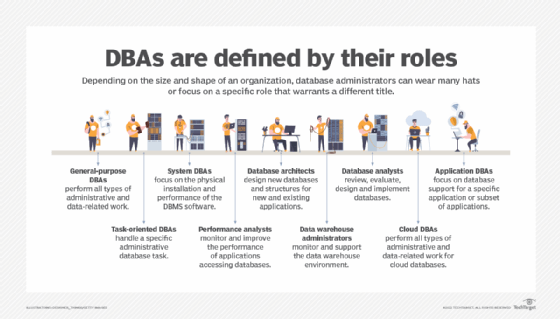
Many different types of DBAs exist, the most common type being the general-purpose DBA, who performs all types of administrative and data-related work. However, it's not uncommon for DBAs to focus on specific problem domains. A DBA, for example, may focus entirely on database design, perhaps broken into logical design and physical design, specialize in building systems, concentrate on maintaining and tuning existing systems, or center attention on narrow areas of database management and administration.
Within larger organizations, DBA responsibilities typically are split into separate types of roles. Beyond general-purpose, the primary roles include system DBA, database architect, database analyst, application DBA, task-oriented DBA, performance analyst, data warehouse administrator and cloud DBA.
System DBA
In this role, the focus is on technical, rather than business, issues. The system DBA is knowledgeable in the arcane technical details of how the database is installed, configured and modified. Typical tasks center on the physical installation and performance of the DBMS software and can include the following:
- installing new versions and applying fixes;
- setting and tuning system parameters;
- tuning the operating system, network and transaction processors to work with the DBMS; and
- ensuring appropriate storage and memory are available for the DBMS.
System DBAs are rarely involved with the actual database and application implementation. They may get involved in application tuning when operating system parameters or complex DBMS parameters need to be altered.
Database architect
Primary responsibility is the design and implementation of new databases. The database architect designs new databases and structures for new and existing applications and is rarely involved in the maintenance and tuning of established databases and applications. Typical tasks include the following:
- modeling logical data;
- translating logical data models into a physical database design;
- analyzing data access requirements to ensure optimal database design and efficient SQL access; and
- creating backup and recovery strategies for new databases.
Database analyst
Sometimes junior DBAs are referred to as database analysts. The database analyst's role may be similar to that of the database architect. The database analyst designation may just be another name for a database administrator.
Application DBA
Focus is on database design and the ongoing database support and administration for a specific application or subset of applications. The application DBA is more likely an expert in writing and debugging complex SQL and will understand the best ways to incorporate database requests into application programs. Furthermore, application DBAs typically are responsible for managing and refreshing test data for application development teams.
Not every organization has an application DBA on staff. In that case, the general-purpose DBA supports specific applications while also maintaining the organization's database environment. But even with an application DBA on board, general-purpose DBAs are still required to support the overall database environment and infrastructure.
Task-oriented DBA
This specialized DBA focuses on a specific administrative task and is uncommon outside of large IT shops. A backup-and-recovery DBA, for example, would be task-oriented to ensure the organization's databases are recoverable, including creating backup plans, building and testing backup scripts, testing recovery scripts and driving recovery tasks when required. The backup-and-recovery DBA also participates in building and testing disaster contingency plans for the company's databases.
Performance analyst
As the most common task-oriented DBA, the performance analyst focuses entirely on monitoring and improving the performance of applications that access databases. A performance analyst is an expert in SQL coding for performance and knowledgeable in designing and building high-performance databases. Performance analysts should have a deep understanding of the DBMS, collaborate with other DBAs to implement appropriate changes when required and communicate with application developers in their language to facilitate appropriate program changes for performance.
Data warehouse administrator
This fully capable DBA has the knowledge and skills to monitor and support the data warehouse environment. Data warehouse administrators understand the differences between a database that supports online transaction processing (OLTP) and a data warehouse and must have experience in the following areas:
- business intelligence (BI) and query tools;
- specialized database design for data warehousing;
- ETL skills; and
- knowledge of data warehousing technologies, such as online analytical processing (OLAP) and star schema.
Cloud DBA
As companies increasingly migrate workloads to the cloud, the cloud DBA has become more popular and performs many of the same tasks as a general-purpose DBA, but for cloud database implementations such as on AWS and Microsoft Azure. The cloud DBA understands the services the cloud provider offers, including backup and security, to implement databases in the cloud. Cloud DBAs need to be aware of latency, fault tolerance and especially cost management because adding data or workloads to a cloud implementation can significantly increase costs.
Data admin vs. database admin vs system administrator
Although similar, the roles and responsibilities for a data administrator, system administrator and database administrator are different.
Data administration separates the business aspects of data management from the technology. The data administrators are aligned more with the business than with IT, translate business lexicon into a logical data model and work with the DBA to translate models into actual databases.
System administrators are responsible for the DBMS installation, configuration and setup but typically have no responsibility for database design and support. They ensure the IT infrastructure is conducive to database development by setting up the DBMS appropriately, applying ongoing maintenance from the DBMS vendor and coordinating migration to new DBMS releases and versions.
These duties typically become the responsibility of DBAs in organizations without data and system administrators.
Functions of database administrators
The primary function of a DBA is to implement, maintain, optimize and manage database structures for the enterprise. The DBA keeps databases and applications running up to PAR (performance, availability and recoverability), while handling additional functions.
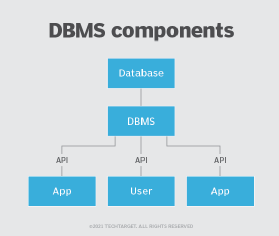
As the central point of contact for information about the company's database management systems, DBAs must keep up to date on the latest versions and capabilities of each DBMS. They also must educate and inform application developers and other users about how to use the DBMS and its facilities.
In addition, DBAs work with application developers to ensure accurate and efficient application design for database access. DBA tasks include interfacing SQL with traditional programming languages, selecting the type of SQL to use, using middleware and APIs such as REST, ODBC, JDBC and SQLJ effectively, defining transactions and determining the appropriate use of frameworks such as Java EE and .NET. At times, DBAs may be asked to modify or write application code to help development projects.
Database performance is the optimization of resource usage to increase throughput and minimize contention, enabling the largest possible workload to be processed. Ensuring efficient performance of the database and applications that access it is a core function of database administration.
When confronted with performance problems, the DBA must be capable of performing root cause analysis -- identifying the cause of the problem so it can be resolved. This task requires the ability to locate bottlenecks and points of contention, monitor workload and throughput, review SQL performance and optimization, monitor storage space and fragmentation, and view and manage the system and DBMS resource use.
Administering a DBMS usually requires additional tools than those provided with the DBMS itself. DBAs must understand the strengths and weaknesses of native DBA tools, develop a strategy for addressing the weaknesses and implement tools that improve the performance, availability, administration and recovery of the databases they manage.
Educational requirements for DBAs
The database administrator is expected to stay abreast of emerging technologies and new design approaches. Typically, a DBA has a bachelor's degree in computer science or information science from an accredited university or college, as well as some on-the-job training with a specific database product. In some cases, DBAs may not be required to have a bachelor's degree if they have extensive information technology work experience.
Many DBAs have prior experience as application programmers and excelled at accessing databases using SQL embedded in COBOL, Java, C or other popular programming languages. DBAs are expected to be proficient in writing and debugging SQL.
A DBA is usually expected to have experience with one or more of the major database management products, including the following:
- IBM Db2
- Microsoft SQL Server
- MongoDB
- Oracle
- postgreSQL
- Redis
- MySQL
DBAs may also possess in-depth technical skills in related technologies such as DevOps software like Docker, Kubernetes and Git, ERP packages like SAP, operating systems like Linux and z/OS and storage software.
Certification programs are available for most of the popular DBMS platforms, and many organizations expect DBAs to be certified in the database systems they manage. Although not as important as on-the-job experience, DBAs who have kept up to date with their certification should have relevant skills and knowledge about the features, functions and capabilities of the DBMS they're certified in.
Salary range and employment outlook for DBAs
A database administrator's job can be rewarding and well-compensated. According to the U.S. Bureau of Labor Statistics, the median annual wage for a DBA is $98,860, but salaries can range from a low of $54,070 to a high of $155,660 depending on factors such as experience, geographical location and industry.
Another important consideration is employability. According to the U.S. Bureau of Labor Statistics Occupational Outlook Handbook, "Employment of database administrators is projected to grow 8% from 2020 to 2030, about as fast as the average for all occupations."
Database administration as a career is under pressure from cloud computing services, such as the DBaaS model, that provide some of the tasks heretofore provided primarily by DBAs, including database installation, provisioning, patching and some types of backup and performance monitoring. As a result, database administrators are increasingly more focused on applications than systems, because cloud service providers typically don't offer application-level services. In addition, DBAs are spending more time interfacing with developers, managing test data, resolving problems and optimizing performance than they do on installation and patching.
Another nuance is the misconception that organizations don't need DBAs when they move data to the cloud. As DBA requirements shift more toward application support than system support, failing to staff DBAs for a cloud database infrastructure can result in inefficient applications, insecure data and perhaps exorbitant cloud service provider costs.