Data architect skills required, responsibilities and salaries
When considering a career as a data architect, learn about the required skills and education, plus job responsibilities, salary ranges and typical interview questions and answers.

A data architect visualizes and creates a framework for an organization's data management system that aligns with enterprise strategy and business architecture.
As senior-level IT professionals, data architects are responsible for building and managing a company's enterprise data architecture. They typically develop a business case for modernizing and expanding the enterprise's data warehouse to improve efficiency and provide employees with consistent and reliable access to key data.
Data architects also support business initiatives to ensure the enterprise follows best practices for data standards and data management. They examine data sets, identify patterns and use that information to help their company gain a competitive advantage.
5 steps to becoming a data architect
Formal education, internships, certifications and relevant work experience are integral parts of the data architect skills required in securing a job and advancing a career as a data architect:
This article is part of
What is data architecture? A data management blueprint
- Earn a bachelor's degree. An individual pursuing a career as a data architect should obtain a bachelor's degree in one of the following disciplines: computer engineering, computer science, IT or a related field. Many organizations require candidates for senior data architect positions to hold a master's degree in data science or computer science.
- Work as an IT intern. Data architect isn't an entry-level position, so individuals should acquire as much IT experience as possible in preparation for this role.
- Acquire entry-level IT experience. Before becoming a data architect, individuals will likely need at least three to five years of experience in an entry-level IT field like programming or database administration.
- Secure a job as a data architect. Careers as a data architect are possible in a wide variety of companies across several industries that collect and process large amounts of client data.
- Add professional certifications. Among the certifications available to data architects are the IBM Certified Data Architect -- Big Data, Salesforce Certified Data Architecture and Management Designer, and Institute for Certified Computing Professionals' Certified Data Management Professionals.
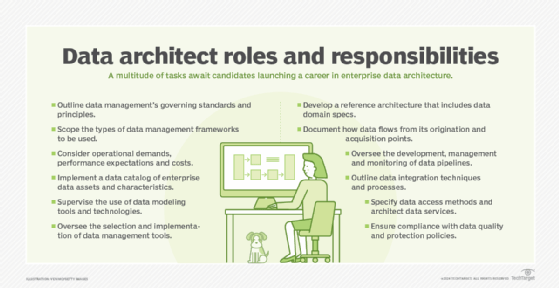
Responsibilities of a data architect
There's no shortage of responsibilities in a data architect job description, including research, design, evaluation, integration, deployment, monitoring and collaboration. The following are among the data architect's tasks:
- Collaborate with company management and IT teams to develop a data strategy that meets corporate needs and industry requirements.
- Create an inventory of the data necessary to build and implement a data architecture.
- Envision data pipelines and how data will flow through the enterprise.
- Maintain a repository of all data architecture procedures and artifacts.
- Evaluate current data management technologies and what additional tools are needed.
- Determine upgrades and improvements to current data architectures.
- Design, document, build and implement database architectures and applications.
- Build data models for database structures, analytics and AI applications.
- Develop and enforce database development standards.
- Integrate new systems and functions like security, performance, scalability, reliability and data recovery.
- Research new opportunities and create methods to acquire data.
- Develop measures that ensure data accuracy, integrity and accessibility.
- Continually monitor, refine and report data management system performance.
Key skills for data architects
Data architects need to know a variety of programming languages and advanced technologies associated with big data, AI, IoT and the cloud. They must also possess strong written and verbal communications skills and display sharp business insights. Data architect skills required include the following areas:
- Applied mathematics and statistics
- Data visualization, data migration and data modeling
- Relational database management systems
- DBMS software, including SQL Server
- Database and cloud computing design, architectures and data lakes
- Hadoop technologies like Pig, Hive and MapReduce
- Information management and data processing on multiple platforms
- Agile methodologies and enterprise resource planning implementation
- Machine learning, predictive modeling and natural language processing
- Data mining and modeling tools
- Programming languages, including Java, Python and C/C++, as well as unified modeling language
- Operating systems like Unix, Linux, Solaris and Windows
- Application server software as well as backup and archival software
- Systems development lifecycle and project management
- Data management and reporting technologies, predictive analytics, data visualization and unstructured data
- Creative and analytical problem-solving capabilities
- Strong business and communication skills as well as knowledge of the big data industry
Inside data architect salaries
The average annual salary for enterprise data architects in the U.S. was $132,617 as of September 2021, ranging from a low of $36,500 to a high of $190,500, according to ZipRecruiter. Data architect positions pulling in the best salaries were cloud data architect at $170,674, followed by remote solutions architect, IT data architect, platform architect, data architecture director as well as cloud enterprise architect and AWS enterprise architect.
Data architect vs. data engineer
Data architects and engineers work together to conceptualize, design and develop an enterprise data management framework. Data architects create a blueprint for the framework, and data engineers use the blueprint to build the digital framework. Data architects guide the data science team while data engineers provide the supporting framework for the enterprise's data activities.
Because data scientists use large data sets to answer questions, processes must be in place to collect and validate that data and apply it to real-world business operations. Consequently, data engineers focus on gathering huge amounts of data and applying it to specific problems. Data engineers typically don't have to develop complex experimental designs. Instead, they help develop the mechanisms and interfaces that enable the smooth flow of and access to reliable data.
Data architects who are database experts help their companies visualize how the changes in data acquisitions can affect the data they use. Data engineers with deep software engineering knowledge can help maintain and build an information system to support those specifications and changes.
Typical data architect job interview questions and how to answer them
During an interview for a data architect position, the interviewer will ask questions to evaluate the candidate's technical skills. Following are examples of typical questions as well as explanations of the kinds of answers the interviewer is seeking.
What do you see as the most important aspects of a data architect's job?
This question lets the interviewer know that the candidate understands the role and responsibilities of a data architect in the enterprise. Candidates should refer to examples of professional data architect role models. They should also discuss the traits they've developed through their experiences to demonstrate that they're aware of the demands of the position.
What key skills do you think will help you succeed in this job?
This question lets the interviewer assess the candidate's strongest skills and determine how those skills will be an asset to the enterprise. Candidates should describe their strengths and abilities to successfully complete a project and its objective.
Can you describe the key elements of data warehouse architecture and how you apply them?
This question helps the interviewer assess the applicant's knowledge of data warehouse architecture as well as experience working with database systems and structural frameworks. Candidates should cite examples of their work related to data warehousing.
Can you describe a project you've completed in SQL?
This question gives the interviewer insight into the candidate's experience working within the SQL language. Candidates should provide several brief examples of the projects they've worked on in SQL.
As a data architect, have you had to deal with any challenges related to an organization's data security? How did you ensure the data wasn't compromised?
Data security is a top priority for every enterprise, so the interviewer wants to know about the applicant's experiences with issues related to security. Candidates should stress that data security is an important aspect though not the focus of the data architect's role.
Have you ever participated in enhancing an organization's existing data architecture? If so, describe your involvement in the process as well as the impact of those enhancements.
Enterprises want to hire data architects who are willing to participate in improving the efficiency and productivity of current processes and structures. Candidates should demonstrate that they are proactive in making improvements and focused on the bigger picture as well as the routine tasks.